
Keep your product performing
Software changes after launch because the world around it changes. We monitor, maintain and improve live products so they remain reliable, secure, performant and useful as users, systems and priorities evolve.
Built by Pixelette or inherited from another team.
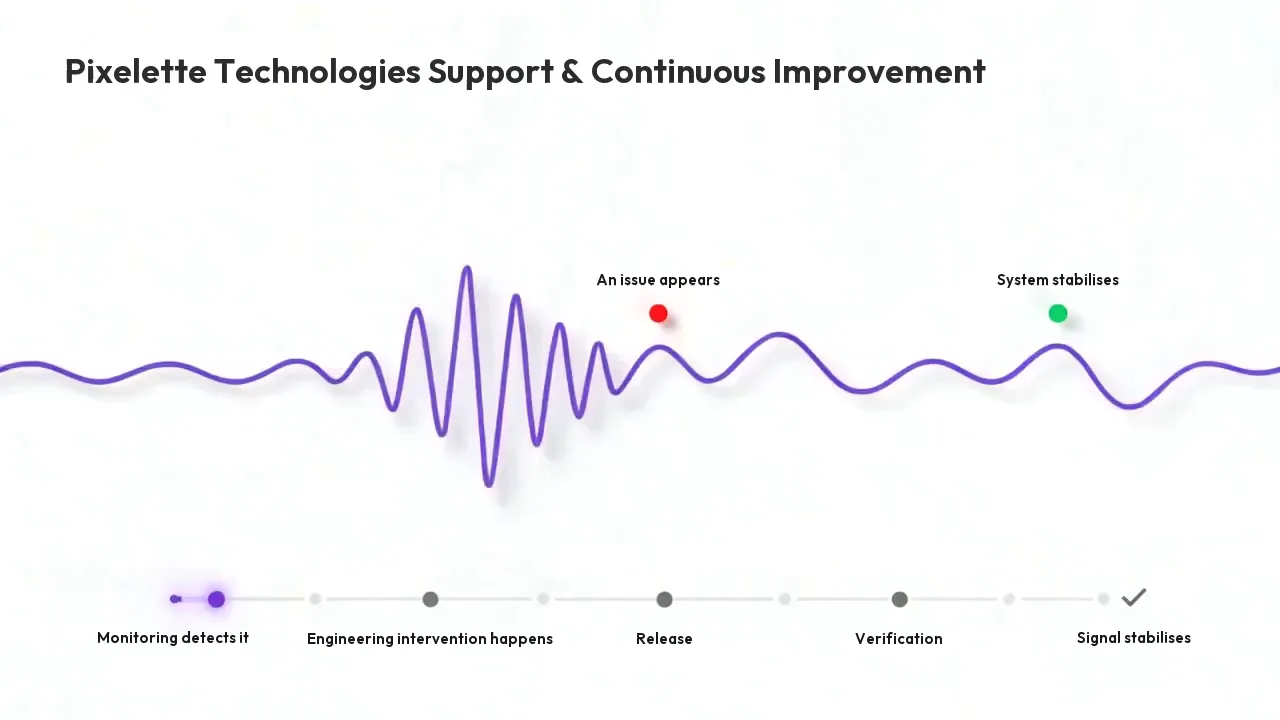
A live product's signal is disturbed when an issue appears. Monitoring detects it, engineering intervention follows, the fix is released and verified, and the signal stabilises.
A continuous product-support cycle moves from monitoring and prioritisation through improvement, release and verification before feeding what was learned into the next cycle.
What changes after launch?
A product in production meets real users, moving environments and new opportunities. Support is how it stays a product rather than becoming a legacy system.
- Real usersNew usage patterns and unexpected behaviour appear.
- ChangeDependencies, APIs and operating environments move.
- LoadUsage and data grow over time.
- New opportunitiesIdeas, requirements and improvements emerge.
- A better productImprovement keeps it relevant rather than legacy.
What we take responsibility for
Keep it running
- Monitoring
- Incident response
- Bug fixing
- Dependency maintenance
- Security maintenance
- Recovery where in scope
Keep it healthy
- Performance
- Reliability
- Observability
- Technical debt
- Release and change management
- Operational resilience
Keep it improving
- Small enhancements
- UX improvements
- Automation
- Modernisation
- Product iteration
- Technical improvements
That work runs on the cycle at the top of this page rather than on a ticket queue: observe, prioritise, improve, release, verify, and feed what was learned into the next round.
Built by Pixelette, or already live
Built by Pixelette
We already understand the architecture, delivery history and decisions behind the product, so development transitions naturally into ongoing support and improvement.
Already live
We can take responsibility for an existing product after first understanding what we are inheriting.
- Architecture
- Codebase
- Infrastructure
- Dependencies
- Deployment
- Monitoring
- Known issues
Support begins once we understand what we are taking responsibility for.
How support is scoped
Support is scoped around the product and the level of responsibility you need us to take.
AI changes after release too
AI-enabled systems can require additional monitoring, because model behaviour, data and operating conditions can change after release. Evaluation, drift and data change are watched alongside the rest of the product. AI evaluation & observability
Questions worth answering
Can you support software you did not build?
Yes. We start by establishing what we would be taking on - architecture, codebase, infrastructure, dependencies, deployment, monitoring and known issues - and support begins once that is understood. We do not take open-ended responsibility for a system nobody has looked at yet.
What does ongoing support include?
Keeping the product running, keeping it healthy and keeping it improving: monitoring and incident response, maintenance and security updates, performance and reliability work, and the planned engineering that adds to the product. The balance between those is agreed rather than fixed.
How do you handle urgent production issues?
Through an agreed route into the team, with severity, risk and impact deciding what is worked on first. Response expectations, coverage and escalation are set per engagement against the product and the responsibility you need us to hold, rather than sold as a standard tier.
Can support include continuous product improvement?
Yes, and for most products that is the larger part of it. Enhancements, usability work, automation and modernisation enter the same cycle as fixes, prioritised on severity, risk and value rather than on whether something is technically broken.
Keep your product performing
Whether we built it or you already have it, start with the product, its current condition and the level of responsibility you need us to take.